

Individuals who suffer from both often have tugs of war going on inside of themselves. So, OCD and ADHD tend to train the mind to get distracted, explore something new, switch from one to another, and OCD acts as a requirement for certainty, repetition, and mental or behavioural checking. This can lead to a vicious circle: a person thinks they will never get things done, but at the same time gets caught in perfectionism loops to fix and redo things due to inattention.
Life can seem frustrating and exhausting: maybe sometimes you’re caught up in one thing, at other times in another. Emotional regulation can also be impacted, which may cause frustration, guilt,t or anxiety if not fulfilled. By providing the support needed to help people manage both conditions successfully.
The Core Conflict: OCD and ADHD Overlap
If someone is experiencing a combination of OCD and ADHD, there are always times when symptoms conflict. ADHD makes for a need for the new. This need can cause clutter, especially when it comes to physical items. Meanwhile, OCD requires order to restrain high levels of panicked emotions. This means an internal battle for those who might be between chaos and control.
Executive Dysfunction is the most prominent co-occurrence between OCD and adhd. In both cases, the daily functioning of the brain is impacted. They both negatively affect your ability to:
- Switch between tasks
- Start new projects
- Remember short-term details
- Control impulses
It is not uncommon for both conditions to mask one another, as they both target the same brain regions. For instance, you may be late to a deadline due to the time management deficit associated with having ADHD. So, both can occur together, causing overlapping symptoms that affect focus and behavior. Learn about signs, diagnosis, treatment, and virtual mental health services by MAVA Behavioral Health.
Key Differences: Difference Between OCD and ADHD
For you to comprehend the comorbidity of this illness, we have to realize the basic differences of ocd vs adhd. At its core, the drives behind the behavior are two totally different things.
| Feature | ADHD | OCD |
| Main Driver | A lack of dopamine. This makes the brain crave excitement. | High anxiety. This makes the brain crave safety. |
| Attention Style | Easily distracted. Can hyper-focus on rewarding activities. | Hyper-focused on threats or perceived dangers. |
| Daily Behavior | Impulsivity, restlessness, and disorganization. | Repetitive actions (compulsions) and strict rules. |
| Risk Habits | High risk tolerance. The person acts quickly. | Low risk tolerance. The person checks for danger. |
Recognizing the Signs: ADHD And OCD Symptoms
Comparing symptoms of ADHD and OCD, it is important to compare and understand the core features of one problem with the core features of the other. But you must also make sure to observe the impact of their collisions.
- Poor concentration on doing daily tasks
- Persistent lack of desire to start work & delay it down the road
- Difficulty with short-term memory (frequently losing keys, etc.)
- Deciding on something without consideration of consequences
- Negative, troubling thoughts that won’t go away.
- Ways to reduce anxiety that you do again and again.
- This involves hand washing, lock checking, and counting.
OCD and ADHD Together Symptoms
If both conditions reside in the same brain, they form certain conflicting and irritating habits:
- Task Paralysis: The ADHD brain doesn’t know how to prioritize or can’t tell what to do out of everything. The OCD brain is a perfectionist brain. The person becomes very ‘cold’ and doesn’t do anything.
- Extreme Routines: A person creates rigid and overactive checking routines. This is done because he or she may forget to do something as a result of having ADHD.
- The ADHD brain is into hyperfocusing—mental loops. It has a hold on a fear that is connected to the OCD. This can make an individual get stuck in hours of agonizing overthinking.
Demographics and Presentations
1-ADHD And OCD In Females
Both conditions have always been undiagnosed by doctors in women. ADHD & OCD in females are different from those of males. There are unique pressures that girls face in society. They are also less likely to have any symptoms.
The inattentive type is typically the presentation for females with ADHD. They wander off into their minds or have an inner restlessness. Heavy masking occurs when somebody has ADHD and OCD in females. According to Psychology Today, ADHD is driven by difficulties with attention and executive function.
A woman can seem well-organized and successful on the outside. Genuinely, serious worries and secret rituals keep that excellent image alive. As women tend to cover up these feelings, symptoms are frequently not correctly identified by doctors as depression or just general anxiety.
2-ADHD and OCD in Children
In school, children with ADHD and OCD are very frustrated because they can’t focus. Hyperactivity is a common symptom in children with ADHD that can make it hard for them to sit still. They can also choose not to turn the work in. They are required to rewrite it so it has perfect handwriting due to their OCD.
Children may not be able to find the words to talk about their frightening feelings. For this reason, OCD compulsions can easily be confused with behavioral problems that are typical of ADHD in children. For instance, a child may be withdrawn from the house, crying. They’re not just “impulsive. They are anxious because some intruder disturbed their strict OCD exits.
The Broader Picture: OCD ADHD and Autism
When autism and OCD happen together, the repetition can look pretty much the same from the outside. It feels hard to sort out because both structure and doing things over and over. I think the autistic part is more about self-soothing and keeping sensory input steady. OCD rituals come from anxious thoughts, though, and are meant to keep something bad from happening. That difference in why it is happening changes how it feels inside, even if the actions are similar.
Adding ADHD into it makes things more tense. One side wants new stuff and quick shifts while the others push for sameness and certainty. It seems like you end up pulled in different directions at once. Everyday tasks start to feel exhausting, maybe because focus and decisions get caught in the middle. This part gets a bit messy.
Getting Clarity: OCD and ADHD Diagnosis
Getting both an OCD and ADHD diagnosis right takes a doctor who has seen this mix before. The symptoms overlap so much that it is easy to miss one while catching the other.
A doctor might notice the messy room and trouble focusing first and just call it ADHD. That leaves out the hours spent going over mistakes again and again because of OCD. Or they might zero in on the hand washing and stop at OCD without touching the attention problems that come with ADHD.
I think the better way to check is to look at why someone is doing something. The doctor asks questions like whether you are cleaning because it feels like something bad will happen if you stop, or because it is just something you wanted to do that day.
Creating Balance ADHD and OCD Treatment
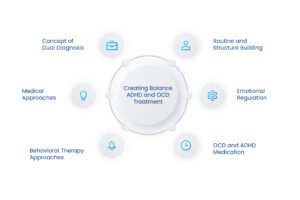
Concept of Dual Diagnosis
The concept of achieving harmony begins with the awareness that attention deficit disorder and obsessive-compulsive disorder can coexist and influence thoughts and actions simultaneously. A dual diagnosis allows for an explanation of why the symptoms of lack of focus and compulsive need to control may occur at the same time. Ignoring the existence of two diagnoses will lead to incomplete therapy of the patient.
Medical Approaches
When managed properly, medication can become an important part of the treatment of both disorders. Medication management services involves using, monitoring, and adjusting medications to ensure safe and effective treatment. SSRIs are usually prescribed to diminish intrusive thoughts and compulsions associated with OCD. It is crucial to find a balance between the management of two diseases.
Behavioral Therapy Approaches
Through behavioral therapy, individuals can learn how to better cope with their impulsive behavior as well as their anxiety-based compulsions. CBT usually involves addressing irrational thoughts and changing emotional response mechanisms. ERP is specifically useful for helping the individual overcome OCD compulsions through controlled exposure to anxiety triggers without performing rituals. ADHD-related therapies address routine planning and attention management.
Routine and Structure Building
Developing a routine is significant in the case of both disorders as it creates an element of order in dealing with them. In the case of ADHD, routines are usually simple and flexible in order not to distract from activities. When it comes to OCD, a routine mustn’t become too strict.
Emotional Regulation
Emotional management plays an important role in dealing with frustrations, anxiety, and mental pressure in both disorders. The person can experience severe inner conflict because of the conflicting tendencies of both ADHD and OCD. Support from family members, friends, and mental health professionals will help significantly to decrease loneliness and psychological stress.
OCD and ADHD Medication
Finding the proper medication for both conditions is a balancing act. Standard medications for ADHD are stimulants that increase dopamine levels and help you concentrate. But the stimulant makes your nervous system faster. That way, you get an extra supply of energy that will make you think about your OCD worries even more.
Standard medications for OCD are high doses of SSRIs. Those drugs help you calm down but also make you tired. The feeling of tiredness makes your ADHD brain fog worse. The following is done to solve the problem:
- They treat the condition that affects your life the most. In most cases, it is OCD anxiety.
- Then they prescribe low doses of non-stimulants for ADHD.
- Another option is to prescribe low doses of stimulants together with SSRIs.
Moving Forward
Life with co-occurring ADHD and OCD can be like a battle where attention, rituals, and obsessive thoughts struggle against each other constantly. Nevertheless, having a dual diagnosis is very helpful because it provides a map that helps one comprehend everything rather than feel overwhelmed by the situation. With professional help, people will be able to see the connection between their two mental health issues and how they influence their lives.
It is possible to get assistance from service providers such as MAVA Behavioral Health, which can provide effective therapy and, if needed, well-planned medication. Medication is necessary for treating symptoms, increasing concentration, and decreasing thoughts when used properly. Eventually, a person will feel more confident and stable after treatment and become able to lead a decent life further on.
FAQs
Is it possible to have OCD and ADHD?
Yes. Comorbidities of ADHD and OCD are common for many patients. Both disorders exist in one brain at once. It results in impulsive actions and compulsions.
Why does my ADHD drug worsen my OCD symptoms?
Stimulants used to treat ADHD make your brain more alert. As a result, you can work efficiently. On the other hand, stimulants raise awareness of any threat. You may experience a worsening of OCD symptoms because of that.
How do ADHD and OCD manifest in females?
ADHD and OCD in females are difficult to see. Girls tend to conceal the disorder. Instead of active hyperactivity, their ADHD is manifested through daydreaming. Invisible mental counting is typical of OCD in girls.
How is ADHD hyperfixation different from OCD obsession?
ADHD hyper-fixation is characterized by feelings of joy and excitement associated with the object of focus. OCD obsession includes feelings of fear and exhaustion.