

Growing up with narcissistic parents can have an influence on your self-image, relational skills, and emotional development. When a parent needs constant attention, ignores your emotions, or always puts themselves first, you may fail to realize if it is a healthy or unhealthy approach to communication.
There are many people who are used to thinking that the behavior of their parents is perfectly normal. But as a child grows up, he or she starts noticing emotional manipulation, criticism, and controlling approaches. It is useful to understand these patterns to set healthy boundaries. At MAVA Behavioral Health, we know how important it is to understand difficult family dynamics and seek mental health services where necessary.
What Is a Narcissistic Person? Understanding Narcissism in Parents
There can be a continued self-absorption, constant need for attention, and difficulty relating to other people’s emotions. Narcissism lies on a spectrum. Individuals might have traits of narcissism without being diagnosed as having a psychiatric illness.
But where narcissistic traits interfere with family relationships and cause emotional problems, it is considered narcissism. Narcissistic Personality Disorder (NPD) is a psychiatric illness, and the signs include:
- Entitlement
- Inability to recognize other people’s needs
- Being touchy about criticism
- Being touchy about criticism
Narcissistic Parents Traits How Narcissistic Behavior Can Affect Family Life
An awareness of the characteristics of the narcissistic parents can give you an insight into how a toxic parent-child dynamic works.
Some of the typical actions include:
1. Demand for Attention
A narcissistic parents will have expectations from his/her offspring for giving attention to his accomplishments, issues, and emotions. They may get irritated if the child receives attention and focuses on personal objectives.
2. No Acknowledgement of Feelings
Narcissistic parents can ignore your feelings and make you feel as if your feelings do not matter. Some of the things they might say are “You are being too sensitive,” “Your issues are not big enough,” or “You should thank me for all the things I am doing for you.
3. Excessive Controlling Behavior
A parent might try to exert influence over a child’s choice of friends, career, looks, or personal life in general. The parent might find it difficult to tolerate the child’s increasing autonomy.
4. Unwillingness to Receive Criticism
Certain narcissists do not cope well with criticism of their actions and either place the blame on others, become irritable, or ignore any faults.
5. Conditional Love or Affection
The parent can express love and approval of the child only on condition that the child conforms to certain criteria.
Signs of Narcissistic Parents: Recognizing Unhealthy Parenting Patterns
The characteristics of narcissistic parents will differ from family to family, and one occurrence alone may not be enough to identify the presence of a narcissistic personality. However, there may be some patterns that can identify problematic family relationships. The narcissistic parents is someone who makes everything in the family revolve around themselves, competing against their own children, devaluing the achievements of their children, and even using guilt as a tool for making key decisions.
Other signs may include crossing boundaries, placing the blame on their children whenever there are problems at home, and expecting absolute loyalty from their children. In other cases, the parent will exhibit signs of favoritism towards one child more than others, find it difficult to sincerely apologize, and employ withdrawal as a punishment technique.
Signs of Narcissistic Abuse from Parents
The symptoms of narcissistic abuse from one’s parents might involve manipulation of emotions, humiliation, threats, or controlling actions regarding the child’s behavior. The narcissistic parents might threaten to stop giving attention or money to their kids, frequently demean and insult them, and also ignore the facts which are known to the latter.
Personal information can be used by the former to make their offspring feel ashamed; in addition, the narcissistic parents would tend to blame the child for all emotional problems and punish him/her for having an individual opinion. Such actions will make one feel scared, helpless, and insecure.
Types of Narcissistic Parents: Different Patterns of Difficult Behavior
The narcissist can present itself in various forms. Knowing about the various kinds of narcissistic parents will assist you in understanding how the behaviors influence family relations.
1. The Overtly Narcissistic Parent
The parent is likely to openly crave attention, admiration, and recognition. They will talk a lot about their accomplishments and demand that their kids appreciate them.
2. The Covertly Narcissistic Parent
The parent is likely to seem insecure, misunderstood, or vulnerable emotionally. They will try to gain attention through guilt or pity.
3. The Controlling Narcissistic Parent
The parent may try to make decisions for his/her children even after becoming an adult. Such parents can consider any act of independence as rebellion.
4. The Competitive Narcissistic Parent
Such a narcissist may have comparisons to himself/herself from their children or feel uneasy when their children succeed.
5. The Neglectful Narcissistic Parent
This parent pays great attention to their own needs and has little concern for the emotions of the child. These kinds of parents are not diagnostic categories but behavioral patterns. A parent may have traits of more than one category.
7 Signs of a Narcissistic Father: Behaviors That May Affect Children
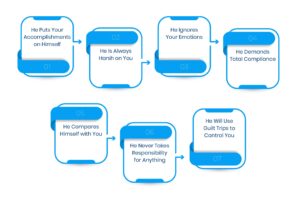
Identifying the 7 signs of narcissistic fathers can help you identify unhealthy father-child relationships.
1. He Puts Your Accomplishments on Himself
He will probably concentrate on how your achievements make him look good, not on what you have done.
2. He Is Always Harsh on You
He always criticizes you concerning how you look, your career, your relationships, and your decisions.
3. He Ignores Your Emotions
He will always tell you to stop whining or that your feelings are unimportant.
4. He Demands Total Compliance
He may have difficulty accepting your independent decisions even as you grow into an adult.
5. He Compares Himself with You
He may try comparing your accomplishments to his own.
6. He Never Takes Responsibility for Anything
He may always shift blame on you and other members of your family during conflicts.
7. He Will Use Guilt Trips to Control You
He may point out the sacrifices he has made whenever you disagree with him.
Examples of Narcissistic Parents: Everyday Situations to Recognize
The following examples are some of the many examples of narcissistic parents whose behavior might be encountered in challenging family dynamics.
Example 1: Dismissive of Your Accomplishments
You get promoted at work and tell your parents about it. Instead of congratulating you, however, they say,
You only got that promotion because I helped you.
Such a statement takes the focus away from your accomplishment and might even cause you to doubt yourself.
Example 2: Making You Feel Guilty
You decide to relocate to work. Your parents’ response might be something like,
After everything I have done for you, this is how you pay me back?
Such a statement can make you feel guilty and prevent you from making decisions on your own.
Example 3: Not Respecting Your Boundaries
You tell your parents that you do not want them to share information about your personal relationships with others within the family. They refuse to respect your boundaries and go ahead and disclose personal information.
Such behavior may strain relationships and cause emotional distress.
Children of Narcissistic Parents: Understanding the Emotional Impact
However, the reactions of children with narcissistic parents differ depending on their situation. There is emotional neglect, but there are also instances where there is criticism, controlling nature, and inconsistency with affection.
It depends on the various issues related to the child’s age, family dynamics, sources of support available, and level of behavior exhibited.
1. Emotional Issues Commonly Experienced
Some of the emotional issues that could be experienced include low self-esteem, fear of failure, inability to express emotions, fear of letting others down, difficulties understanding personal boundaries, and inability to trust people. One might also have tendencies to please everyone and always need validation to prevent conflicts and criticisms.
2. Characteristics of Kids of Narcissistic Parents
The traits of children of narcissistic parents might be a reaction to stressful family environments. One could observe that someone shows people-pleasing tendencies, self-blame, inability to say no, avoidance of confrontations, or fear of being rejected. One could also see oneself as feeling responsible for others’ emotions or not being able to recognize and express their own needs.
These do not describe one’s character or one’s future. With proper help and awareness, one could learn to cultivate better emotional habits and grow in confidence and boundaries.
Adult Children of Narcissistic Parents: Challenges in Adulthood
Even after moving out, adult children who have grown up under the same roof as a narcissist will continue to face emotional problems. The past influences how you relate to other people in your relationships, career, and decisions in life. Guilt may be experienced in the attempt to set boundaries, lack of self-trust, need for validation, avoiding confrontation, or the feeling that you must make your parent happy.
Anxiety in interacting with family members or the fear of disappointing other people might also occur. Despite having grown up with a difficult parent, this does not mean that this determines your future.
Narcissistic Parents how to Deal with Difficult Family Dynamics
If you are asking yourself, “How to handle narcissistic parents? “Your first step is to think about your own safety and boundaries.
You cannot change another person’s actions, but you can choose your reaction to those actions.
1. Set Your Boundaries
Choose which behaviors you will tolerate and set them.
Example:
I am not okay talking about my financial details. Would it be possible for me to keep this information to myself?
2. Don’t Engage in Unnecessary Disputes
Sometimes arguments get tiresome or repetitive. You don’t always have to react to every insult or accusation.
3. Reduce Sharing Personal Details
If your parents are constantly misusing personal details, think of divulging fewer facts regarding your relationships, financial standing, and future.
4. Set Realistic Expectations
Even though you might want your parents to realize your emotions one day, expecting him/her to do so can enable you to make practical choices regarding the relationship.
5. Create a Support System
Your friends, relatives who care for you, and mental health specialists can offer you support.
6. Use Low Contact or No Contact When Needed
In certain cases, limiting your contact can be helpful for your mental health. This will depend on your own personal situation.
Narcissistic Parents Test: Can You Identify Unhealthy Patterns?
Taking a quiz to see if you have narcissistic parents will allow you to think about the repeated patterns in your family relationship. But remember that online tests cannot be used to diagnose your parents with narcissistic personality disorder.
Here is what you can start with:
1. Do my parents tend to disregard my emotions?
2. Do I feel guilty when I state my needs?
3. Can my parents not respect my boundaries?
4. Are my parents constantly criticizing or belittling me?
5. Do I feel responsible for my parent’s emotions?
6. Do my parents blame me for the problems he/she caused himself/herself?
7. Do I fear opposing my parents?
You should seek advice from a mental health professional if you answered “yes” to some of these questions.
Healing from Narcissistic Parents: Steps Toward Emotional Recovery
Overcoming the effects of having narcissistic parents is a process. You might need to work through past events, learn about your emotional reaction, and gain more self-awareness.
Below are some ways that will help you recover.
1. Practice Self-Compassion
Remember that your emotions and needs are important. You don’t have to deserve respect by being successful all the time.
2. Recognize Negative Beliefs
You might have formed some negative beliefs like I always have to make others happy, I am not worthy of happiness”, and Making mistakes means I am worthless. These beliefs will influence your perception of yourself, your relationships, and the way you react to different situations. With the help of a therapist.
3. Get Started by Setting Healthy Boundaries
Begin with healthy boundaries that are simple and easy to set. Work on expressing your needs without feeling that you must give long explanations about them.
4. Build Your Support System Up
Surround yourself with individuals who value your emotions, preferences, and limitations.
5. Look into Therapy
It can aid in dealing with some tough experiences, regulating your emotions, and developing healthy relationships. If you come to MAVA Behavioral Health for mental health services, they could offer you the opportunity to deal with your emotional problems.
Final Thoughts
Having been brought up by narcissistic parents may make one suffer from emotional distress, lack of self-confidence, and trouble trusting others and setting appropriate boundaries. However, there are measures that can be taken to ensure better emotional health and confidence in oneself. One can pay attention to learning about one’s emotions, showing compassion for themselves, setting appropriate boundaries, and cultivating healthy relationships. Having proper assistance will help to overcome the traumatic experiences of the family and learn new ways to cope with them. MAVA Behavioral Health is here to offer you this help.
FAQs
1. How is having narcissistic parents going to impact you?
There are certain characteristics that come with having narcissistic parents that can cause one to feel worthless, pleasing others, anxiety, lack of trust and boundary issues. The effects of these behaviors differ from person to person based on experiences and environment.
2. Can one heal from having narcissistic parents?
Yes. Many have learned how to develop healthy emotions through knowledge, relationships, boundaries, and therapy.
3. Should I break away from my narcissistic parents?
There is no certain answer to this question for all scenarios. For some scenarios, setting up healthy boundaries and reducing contact may do the trick. For others, breaking away from contact is needed to maintain their mental state.
4. Will therapy help me solve the problem of my relationship with narcissistic family members?
Yes, a professional therapist can help you understand dysfunctional relationships, overcome trauma, set up healthy boundaries, and improve your coping mechanisms.
5. Where to go for assistance with my emotional problems related to my narcissistic parents?
You may reach out to a licensed mental health professional or an organization such as MAVA Behavioral Health.