

Dissociation can make one’s daily activities seem strange and distant. There is an estrangement from one’s own thoughts, emotions, memories, surroundings, and even one’s own self. While sometimes there can be temporary estrangement due to stressful conditions, if there is constant dissociation, then it may affect one’s work and other aspects of life.
Learning more about dissociation, its causes, and how one can be helped with it may make dealing with this condition less scary. Dissociation recovery is a feasible goal when the right help is provided.
What Is Dissociation?
It refers to a psychological phenomenon that involves the feeling of detachment from one’s thoughts, emotions, memories, self, or surroundings. The brain may develop this defence mechanism to handle excessive stress, trauma, fear, or emotional pain.
It can manifest itself in varying degrees – from minor cases like daydreaming or becoming lost in thought to more extreme cases that involve memory loss or detachment from reality. Dissociation telehealth services offer convenient access to licensed mental health professionals for assessment, therapy, and ongoing support from home.
Recognizing the phenomenon of it doesn’t mean that any unusual sensation is caused by a dissociative disorder. Various sleep disorders, anxiety, depression, substance abuse, neurological disorders, and other psychiatric conditions can cause similar sensations.
Common Dissociation Symptoms
Symptoms of dissociative experiences might be varied among patients. In some individuals, symptoms might appear mild, and for others, these symptoms will affect daily activities. Symptoms of it might get intensified during times when one is experiencing high levels of stress. Dissociation in some patients can also get worse with reminders of distressing experiences. Signs of dissociation may range from staring blankly, memory gaps, and feeling detached from self and environment to sudden shifts in behavior or mood.
Some common symptoms of it include:
- Feeling detachment from one’s own body or emotions
- Feeling as though one is observing himself outside his body
- Surroundings seeming strange, unreal, distant, or hazy
- Problems with recalling certain events or periods of time
- Loss of sense of time
- Lack of emotion
- Problem with identifying with oneself
- Concentration difficulties
- Memory lapses that cannot be explained
Dissociation Examples in Everyday Life
These dissociative disorders can be mild or serious. When driving down a well-known path, you find that you have hardly any recollection of the drive. While reading several pages of a book, you might fail to recall the contents. In a discussion that is becoming too tense for you, you could find yourself suddenly feeling emotionally detached or even disassociated from your physical body.
This is another form of dissociative disorder, and it is referred to as depersonalization in which you might feel detached from your own body or feelings.
Types of Dissociative Disorders
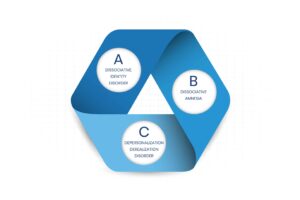
Mental health professionals recognize several types of dissociative disorders. These include:
1. Dissociative Identity Disorder
A dissociative identity disorder (or DID) is characterized by identity states as well as memory, identity, and consciousness disturbances. Symptoms might vary greatly.
2. Dissociative Amnesia
Dissociative amnesia refers to problems with remembering autobiographical material due to stress or trauma. The problem with the memory is more than mere forgetfulness.
3. Depersonalization/Derealization Disorder
Depersonalization/derealization disorder entails either persistent or recurrent depersonalization, derealization, or both. The patient feels detached from oneself or one’s environment without perceiving that it is not so.
What Is Structural Dissociation?
Some trauma-orientated professionals define structural dissociation as a framework to explain varying states of functioning after overwhelming experiences. It could help to explain why various feelings, memories, or reactions seem to be disconnected from each other. It describes trauma-based dissociation, but it cannot replace personal clinical assessment or diagnosis.
Dissociation vs Disassociation: Is There a Difference?
It is also common for people to ask a question about dissociation vs disassociation. The term “dissociation” is used in discussions about mental health issues. According to WebMD, dissociation involves a disconnection from thoughts, memories, feelings, or surroundings. The word disassociation may be found in informal conversations; however, specialists who deal with people’s mental problems use the term “dissociation” while speaking about depersonalization, derealization, dissociative amnesia, and other issues.
How to Come Out of Dissociation
If you are feeling dissociated or out-of-touch, you can use techniques to bring your awareness back to the here and now. The process of learning how to reorient and ground yourself from a dissociative state may require some practice, particularly for times when the experience is triggered by stress or trauma.
Here are a few suggestions:
- Describe your environment. Describe yourself, your location, what the date is, and what you are up to.
- Mobilize your sense of perception. Determine five things that you see, four that you can touch, three that you can hear, two that you can smell, and one that you can taste.
- Focus on your feet. Place your feet firmly on the floor and notice the feeling.
- Take deep breaths. Breathe in and out deeply while focusing on the breathing process through the chest or abdomen area.
- Hold an object. Get hold of an object which has its unique texture, temperature or shape.
- Avoid overstimulation. Find yourself a quiet and comfortable place.
- Get the company of a friend. Having someone close can assist you in grounding yourself into the present.
Dissociation Techniques for Grounding
Certain practical dissociation strategies may aid in increasing presence. These may include such practices as grounding exercises, sense awareness, breathing slowly, keeping a journal, gentle exercise, and regular routines.
The purpose is not to make oneself stop dissociating. In contrast, grounding will help reconnect one with their body, environment, and the present moment. A trauma-informed approach may involve exploration of certain patterns linked with structural dissociation, emotional triggers, memory issues, and protection mechanisms.
Therapy for Dissociation
Dissociation therapy can assist in learning about symptoms, identifying triggers, establishing grounding techniques, and adopting new methods to cope with distress. The treatment usually depends on the symptoms and any issues that are associated with them. A mental health expert might use trauma-informed interventions, cognitive-behavioral techniques, stabilization processes, and other interventions that are evidence-based and appropriate for the individual.
It is crucial to have a secure therapeutic alliance. The intervention must take place at a pace that you can manage without rushing into revisiting painful memories.
Dissociation Treatment: What Can Help?
The treatment of it normally revolves around safety, symptom management, emotional regulation, and the overall mental well-being of an individual. The doctor could assist in identifying the symptoms and developing a strategy for dealing with dissociation. It includes the treatment of individual psychotherapy, emotional regulation, and trauma-informed therapy, among other factors. You could further benefit from good sleep management and better stress management in addition to any drug issues that you might be experiencing. A doctor could prescribe medication to you in case you have a certain mental problem which is treatable with the use of medication.
Medication for Dissociation
Medication cannot treat it universally. However, a physician may prescribe medication as part of the treatment for anxiety, depression, post-traumatic stress disorder PTSD, and sleep disturbances, among others.
It is imperative for any questions pertaining to medication management for dissociation to be directed to a healthcare provider. Do not make changes in your medication without seeking professional advice.
Is There a Dissociation Test?
Anyone interested can readily access an online dissociation test, which includes questionnaires on memory loss, depersonalization, and derealization.
While these questionnaires can sometimes be helpful in organizing your experience, an online test will not give you a diagnosis, which takes into account all the symptoms, your personal history, your physical state, any medications you might be taking, substance abuse, trauma, or any number of other factors.
Dissociation Recovery: Can You Get Better?
Improvement is definitely possible. Recovery from it might include identifying early warning signs, developing coping mechanisms for grounding, regulating emotions, trauma resolution if necessary, and having good support relationships.
The process of recovery might be quite nonlinear. Stress levels may temporarily increase the severity of symptoms, and recovery will include learning how to react to symptoms differently.
A trauma-informed perspective on structural dissociation may help some individuals to understand the patterns of emotional detachment.
How to Help With Dissociation
If you are interested in knowing how you can help someone experience dissociative episodes, it is essential that you concentrate on creating safety, being patient, and having a calm conversation. Speak in a calm voice and avoid judging, especially if there is any confusion or distress. In case the person seems to be confused about their location, tell them where they are and encourage grounding rather than requiring immediate explanations. Find out what makes them feel safe, consider their individual boundaries, and seek professional help if it starts influencing their everyday life. Avoid putting pressure on them to remember their traumas.
When to Seek Professional Help
In case you suffer from dissociative episodes and notice that they lead to significant distress, affect your memory, relationships, or work, or interfere with your daily activities, you might want to consult a mental health professional. At MAVA Behavioral Health, you will receive compassionate mental health services in which you can share your hardships and gain insight into symptoms and treatment options.
Final Thoughts
It might seem like a confusing and scary thing, but by becoming knowledgeable about it, you will decrease your confusion. Some symptoms include emotional numbing, trouble with memory, separation from one’s body, and feeling like the surroundings aren’t real. Practising grounding exercises, getting treatment for it, as well as dealing with the accompanying problems in one’s mental health, can help make great progress. Some might find the knowledge about structural dissociation helpful when trying to make sense of their patterns of trauma.
FAQs
1. Is there any medicine for it?
There is no one-size-fits-all prescription medicine for dissociation. If needed, the psychiatrist will be able to prescribe suitable medication for other co-morbid problems like anxiety, depression, PTSD, insomnia, etc.
2. Can a dissociation test taken online give me a diagnosis?
Absolutely not! A dissociation test may assist you in identifying your symptoms and discussing them further with a healthcare provider.
3. Is dissociation the same as dissociative identity disorder?
Not necessarily! ‘Dissociation’ is the umbrella term for various states, while dissociative identity disorder is a specific condition with unique diagnostic features.
4. What is meant by structural dissociation?
Structural dissociation is a theoretical construct that some trauma-centred settings use to explain the dissociation of certain psychological functions. However, it is not meant for self-diagnosis.
5. Does dissociation ever disappear?
Many individuals manage to recover through the right support and therapy. Recovery may include learning coping mechanisms, regulating emotions, dealing with underlying issues, and having good social support.