

OCD thoughts may be unwelcome, scary, repetitive, and uncontrollable. OCD thoughts may include thoughts that conflict with your beliefs and morals, fear of some terrible events taking place, or the strong need for specific actions to be completed so you can feel safe. When these thoughts keep getting in the way of your daily routine, having knowledge of what is going on may facilitate getting the appropriate help.
It is a mental illness that includes recurring thoughts, images, impulses, fears, and repetitive behaviors or mental acts. The right treatment will enable you to cope with the situation. You can get professional mental health services at MAVA Behavioral Health, which will help you figure out your symptoms and respond to them properly.
What Is OCD Disorder?
Therefore, what is the disorder of it? The OCD goes beyond simply enjoying being clean and having everything organized. The condition entails obsessions, compulsions, or both on a constant basis. Get compassionate support for OCD thoughts through convenient telehealth services with MAVA Behavioral Health.
An obsession refers to an unwanted thought, idea, image, fear, or urge that keeps intruding on your mind. Compulsions, on the other hand, include behaviors or rituals that one feels obliged to engage in to alleviate their anxiety.
You may experience fear of contamination and be compelled to wash your hands frequently. Additionally, you might be afraid of making a fatal mistake and keep checking a door, appliance, message, or document.
OCD Thoughts and Intrusive Thoughts
Everyone has unpleasant thoughts now and then. But for someone who suffers from it, such thoughts can be persistent, unpleasant, and hard to ignore.
Intrusive thoughts with it could include thoughts which are disturbing precisely because they clash with what you believe in or how you think. An intrusion doesn’t necessarily mean that you want it or that you will carry it out.
OCD Thoughts Examples
Such ideas may lead to severe anxiety and prompt one to check over and over again, seek reassurance, avoid, count, pray, review memories, or engage in any other compulsion.
Examples of OCD thoughts could be:
- Fear of hurting yourself or someone else
- Fear of accidentally causing an accident
- Fear of making an irremediable mistake
- Extreme uncertainty when making routine decisions
- Belief that something bad is going to happen unless you do something
- Ruminations about your relationships and how you feel
Types of OCD
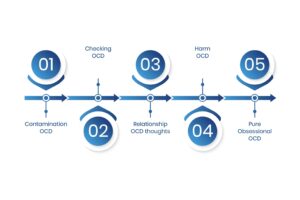
Here are some common themes for people who suffer from it. You could fall into one of the themes or all of them.
1. Contamination OCD
You could feel excessively worried about germs, dirt, illness, chemicals, or contamination. Cleaning, washing, avoidance of certain things, or reassurance seeking might be some common responses to your fears.
2. Checking OCD
You could constantly keep checking locks, appliances, emails, texts, documents, or anything else due to doubt.
3. Relationship OCD thoughts
Your recurrent thoughts related to relationship it could include doubt about whether you really love your partner, whether you made the right decision in life regarding marriage, or whether your relationship is right.
4. Harm OCD
You might suffer from unwelcome obsessions and/or images related to harm, either accidental or deliberate. You might find such thoughts scary, especially when they go against your moral code.
5. Pure Obsessional OCD
You might suffer from very intrusive obsessions but with little visible compulsion. Mental reviewing, analysis, and seeking reassurance or mental repetition can all be compulsion mechanisms.
OCD Intrusive Thoughts Examples
OCD and Intrusive Thoughts Examples can be very useful for you to understand that such thoughts can come in different ways.
You may suddenly feel What if I hurt someone? or What if I’ve got into an accident without even remembering it? You might always doubt that you have done anything unintentionally wrong or that the relationship is perfect.
Symptoms Obsessive Compulsive Disorder Can Cause
Obsessive-compulsive disorder symptoms may include a process that begins with a trigger, followed by an obsession, anxiety, compulsion, relief, and further doubt. You may have recurrent unwanted thoughts, anxiety or extreme distress, constant checking, excessive cleaning and washing, reassurance seeking, avoidance behavior, mental review, counting and repetition, trouble making decisions, or spending lots of time on coping with obsessions. Once these symptoms start impacting your work, relationships, sleep, education or life in general, you might want to seek professional assistance.
How to Deal With OCD Thoughts
It is important to begin learning how to deal with it by modifying the way that you relate to the thought and not by gaining full control over your thoughts.
You may try observing the thought without analyzing it at once. You should stop asking yourself what this thought means to you but recognize it as an intrusive thought.
You shouldn’t be trying to see if the thought went away. It will occupy your mind with obsession. According to Verywell Mind OCD involves persistent, unwanted thoughts and repetitive behaviors that can cause significant distress.
How to Stop OCD Thoughts Naturally
Remember that if you are looking for a way to stop it naturally, it is not about getting rid of all the thoughts you do not like since these kinds of mental experiences happen to everyone. Try to reduce the importance of these thoughts and learn to react without reinforcing the OCD process. In order to maintain your mental health, you can keep a regular sleeping schedule, exercise regularly, use mindfulness techniques,
stop seeking excessive reassurance, avoid avoidance strategies, develop your skills to cope with stress effectively, and have a consistent daily schedule. You can also practise the strategies suggested by your therapist to help you cope with anxiety and OCD thoughts.
How to Fight OCD Thoughts Without Feeding the Cycle
Fighting it does not require engaging in an argument about each thought. Arguing over an obsession may be yet another compulsive behavior.
Instead, try accepting the uncertainty.
For instance, do not ask yourself repeatedly whether you locked the door, but accept your uncertainty and refrain from going back when needed.
Initially, it might be difficult to follow this rule, but limiting compulsive actions can help interrupt the vicious circle of OCD.
How to Overcome OCD Intrusive Thoughts
Overcoming OCD intrusive thoughts frequently requires professional counselling, particularly Exposure and Response Prevention (ERP).
ERP will help you confront your triggers as well as lessen the behaviors that you do to feel better. If you practise diligently, you will be able to understand that your anxiety can come and go without doing a compulsion.
Cognitive Behavioral Therapy (CBT) is commonly used in OCD, and ERP is just one form of CBT. Your mental health care provider can suggest what works best for you.
Treatment for OCD Intrusive Thoughts
Treatment options for it intrusive thoughts will be based on several factors, including symptom intensity, individual circumstances, previous treatment and additional mental health issues.
Options for evidence-based treatment include:
Exposure and Response Prevention
ERP treatment allows gradual exposure to feared situations or intrusive thoughts while not giving in to compulsions.
Cognitive Behavioral Therapy
CBT treatment allows you to change your negative thought patterns.
Medication
A qualified health practitioner may prescribe online mental health medication for individuals with it. Some of the commonly prescribed medication includes selective serotonin reuptake inhibitors (SSRIs). When making decisions on which medications to prescribe, there must be a qualified practitioner to offer advice on all matters regarding the benefits and side effects, among others.
For someone wondering what the best medication for OCD intrusive thoughts is, the truth is that there isn’t any medication that fits all individuals with the condition.
Can OCD Cause Suicidal Thoughts?
It may be a question that arises in your mind whether it can give rise to suicidal tendencies. Indeed, in it, there can be feelings of extreme distress, hopelessness, or suicidal or death-related thoughts. Some individuals may even suffer from unwanted suicidal obsessions which can be scary and go against their desires.
Nevertheless, suicidal tendencies may sometimes arise along with the state of depression or other psychological disorders. If you suffer from such suicidal thoughts with intent on hurting yourself or cannot keep yourself safe, then seek emergency care.
How to Get Rid of OCD Thoughts
Looking for ways to stop obsessive-compulsive disorder (OCD) thoughts may actually reinforce the process since fighting an intrusive thought will draw even more attention to it.
A better idea is to learn how to recognize this thought while not attributing any extra significance to it and not reacting to it in any way. Proper treatment can help you build up tolerance to uncertainty and decrease the time spent on it.
How to Manage OCD Thoughts in Daily Life
Small steps may be added to professional interventions and improve your OCD thoughts. Begin by recognizing any OCD patterns and triggers and do not react right away. Avoid seeking reassurance; avoid unnecessary checking, rituals, and other compulsions. You can practice mindfulness and acceptance to learn how to look at unwanted thoughts and pay less attention to them.
Get Professional Support for OCD
Seeking assistance from professionals can assist you in gaining insight into your symptoms and finding useful strategies for managing them.
MAVA Behavioral Health can be a place to start considering ways in which you can address your mental well-being and OCD issues. Seeking professional advice can be an important step in taking control of your life and freeing yourself from intrusive thoughts and compulsions.
Final Thoughts
They can handle it differently, even if it seems intimidating, scary, and uncontrollable. Not every thought that comes into your head needs to be believed, and not every thought that you don’t like needs to go away for you to move on.
You can acquire skills to cope with OCD symptoms, decrease compulsions and boost confidence in yourself. Proper treatment, including cognitive behavioral therapy (CBT) and exposure and response prevention (ERP), can help you find useful techniques to overcome obsessions and compulsions.
If it make it hard for you to maintain relationships, focus at work, sleep or just perform normal activities, contact MAVA Behavioral Health today.
FAQs
1. How do I stop reacting to the OCD thoughts?
There is an option of learning to notice the thought without constant analysis, checking, avoidance, and seeking reassurance. An ERP practitioner may guide the process.
2. Are OCD thoughts gone forever?
OCD symptoms are possible to improve greatly with the right treatment plan. Instead of trying to get rid of the thoughts, treatment usually aims at decreasing the discomfort from them.
3. When do I need to get help with OCD?
You should consider getting professional help if obsessions or compulsions take up a lot of your time, are distressing to you, interfere with your life, or make you unable to engage in personal, work, academic, or other pursuits.
4. Is there any medicine for OCD?
Yes, some medicines can help with reducing the symptoms of it in certain cases. Only a professional in healthcare can decide whether you need the medicine or not.
5. Which treatment is the most effective for OCD?
Cognitive behavioral therapy with ERP techniques has proven very effective in the treatment of it. The use of medication can be helpful in certain cases.