

Social exhaustion may be very comforting and supportive to having some connections and relations. However, too much interaction, constant communication, or the need to be always available socially will leave one totally exhausted. If conversations, socializing, meetings, messages and any other form of social interaction seem to become exhausting to you, then it is likely that you will suffer from social exhaustion.
Social exhaustion is not just the regular fatigue; it affects one emotionally, mentally and even physically. It is known to reduce one’s emotional energy, motivation and the ability to enjoy one’s social experiences.
What Is Social Exhaustion?
It occurs when one gets mentally and emotionally exhausted through social interactions. Engaging in talk, listening, social networking, attending meetings, answering messages, meeting social obligations, or adjusting to changing surroundings might be exhausting. Social exhaustion does not mean you hate people or want to live alone all your life.
It can be addressed through telehealth services, offering convenient access to mental health support from the comfort and privacy of home.
It can occur after:
- Being in endless meetings all day long
- Attending many social events in quick succession
- Conducting conversations on the internet frequently
- Working in a very interactive setting
- Navigating tough conversations
- Spending long hours in stimulating situations
What Causes Social Exhaustion?
If you observe any of the signs mentioned above, there might be a chance that this issue may disrupt your mental health in the future. Therefore, seek professional help and contact us at MAVA Behavioral Health to manage the signs.
There are some issues that may result in exhaustion of an individual socially.
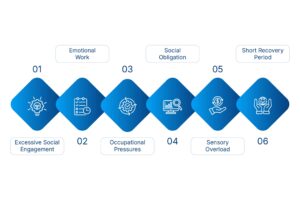
1. Excessive Social Engagement
Nonstop communication and engagement can offer little room for rest. Sometimes even positive social engagement may become exhausting when there is no chance for relaxation.
2. Emotional Work
Helping people, listening to their stories, dealing with conflicts, or even picking your words can take a toll on you emotionally. Such work can lead to social exhaustion as well as mental exhaustion.
3. Occupational Pressures
Occupational demands in the contemporary world can include meetings, presentation, collaboration, telephonic communication, customer service, and instant messaging. It may lead to it due to work if the workday consists of no breaks.
4. Social Obligation
Being obliged to reply immediately, be at every occasion, keep the conversation going, and always be enthusiastic might add to emotional pressure.
5. Sensory Overload
Crowded places, noisy environments, constant reminders, and many simultaneous conversations can overload the sensory system. If stimulation continues for a longer period, social interaction becomes even more tiring.
6. Short Recovery Period
When there is a busy schedule, recovery from fatigue may become impossible. Lack of enough calm intervals amid social engagements leads to exhaustion.
Signs of Social Exhaustion
The ability to identify symptoms of it will make it possible for one to know how to take a breather before social exhaustion takes hold. One may find it difficult to socialize because one has a strong urge to be alone, irritability when conversing with someone or difficulty in concentrating after being in contact with people. Indicators include emotional exhaustion, avoiding calls and messages, needing quiet time, feeling overwhelmed by noise, and being less motivated to socialize.
One may find it difficult to articulate his/her ideas, feeling tired despite having adequate physical rest and being overly sensitive to noise and distractions. After a socially exhausting day, one may also feel overwhelmed by the thought of socializing and feeling mentally stuffed.
Introvert social exhaustion
Experiences associated with being a social introvert can in some cases coincide with it, although introversion and exhaustion are not the same things. Typically, social introverts prefer low-stimulation environments and private time to recharge. Social exhaustion, in turn, means a condition of having one’s emotional or psychological resources exhausted, which can happen to anyone.
A social introvert might be able to relate to close relationships but will get exhausted from too much interaction. Extremely outgoing people can exhaust themselves by socializing too intensely. Knowing the distinction will help avoid unjustified judgement towards oneself. Having to be alone doesn’t necessarily mean that anything is wrong.
Social Exhaustion ADHD
Social exhaustion from ADHD may happen in cases where social interactions necessitate a great deal of conscious effort. Listening to a conversation, reading social signals, dealing with impulses, responding to sensory input, or changing tasks may demand extra mental effort.
ADHD issues can make long conversations, meetings, crowds, or unexpected social events very taxing. According to PsychCentral, social exhaustion can happen when prolonged social interaction leaves you feeling emotionally and mentally drained.
If you experience it in conjunction with attention problems, impulsivity, sensory sensitivity, or other problems on an ongoing basis, it may be helpful to consult a licensed mental health expert.
Social Exhaustion From Work
Social exhaustion at work becomes highly evident when one’s job involves constant interaction and communication during work hours. One’s work involves meetings, collaborating, providing customer services, presenting, calling, emailing, messaging, and socializing. The task and social transitions that one must make constantly during the day put a lot of demands on one’s mind. You might consider incorporating small breaks into the workday routine – if you can afford five or ten minutes between meetings or tasks.
Taking several minutes free from notifications, conversations, and meetings gives your mind some time for recovery. Other useful techniques are scheduling productive work periods, taking breaks between meetings, restricting unnecessary notifications, finding a quiet spot whenever possible, skipping non-essential meetings, setting up boundaries after hours, and having a proper lunch break rather than eating while working.
How to Recover From Social Exhaustion
1. Make Time for Silence
It is okay to spend some time alone in which you do not have to speak, receive notifications, or interact with anyone. Activities like reading, walking, journaling, or listening to music may be helpful in this regard.
2. Lower Your Social Obligations
You do not have to be at every single event to which you get invited. It is okay to limit your social obligations when you feel too much on your plate.
3. Ensure Your Good Sleep and Rest
When you don’t get good sleep, it becomes difficult for you to control your emotions and focus.
4. Set up Digital Boundaries
Using social media and digital messages can lead you to be socially accessible 24/7. Disable any non-essential notifications and set aside times where you will not respond to any messages.
5. Focus on Quality Not Quantity
You don’t always have to interact all the time because your relationships matter. Spend your time on interactions that make you feel supported and not continuously drained.
6. Try Simple Stress Management Techniques
Breathing, being mindful, moving gently, stretching, and going outside can all decrease your stress levels.
How to Overcome Social Exhaustion
Being able to overcome it is more than just having one day off. To improve, realize your limitations and identify what causes your exhaustion. First, find out what makes you experience it. Think about what kind of social interaction exhausts you the most, how long you can stay in a social environment without getting tired,
what kinds of environments are overloading you, how interactions at work influence your evening mood, how much time you need to spend alone, and how virtual conversations affect your state. Find out what can help you maintain enough energy and create reasonable boundaries for yourself.
When Social Exhaustion May Need Professional Support
Temporarily it is normal, particularly during times of activity and stress. Nevertheless, it becomes necessary to pay attention to prolonged exhaustion when it starts hindering your performance at work, personal relations, or sleep patterns or affects your emotional state.
Seek the help of a mental health specialist if you experience frequent social exhaustion with extreme withdrawal, depression, excessive anxiety, inability to function properly, or unrelenting social exhaustion despite good sleep.
MAVA Behavioral Health will help you examine your issues associated with emotional exhaustion, stress, anxiety, ADHD problems, and many others.
Social Exhaustion vs. Mental Exhaustion
While social exhaustion and mental exhaustion are often indistinguishable in terms of symptoms, they do not necessarily arise from the same causes.
It occurs because of extended periods of socializing, communication, emotional labour, or social engagement. Mental exhaustion happens as a consequence of extended concentration, decision-making, working, stress, and mental overwork.
Both social and mental exhaustion can be experienced at the same time. For instance, an exhausting working day full of meetings can lead to both types of exhaustion.
Treatment for social exhaustion
A treatment for it could involve therapy, managing stress, maintaining good boundaries, taking time off, and other approaches that contribute to emotional well-being. Finding time for rest, minimizing social pressures that overwhelm a person, placing limits on working and communicating and taking relaxation could all contribute to restoring energy levels. The telehealth service could offer a useful option for getting professional assistance if it starts to impact one’s everyday functioning.
Medication for social exhaustion
Doctors rarely use medications as a primary solution to it. In case there is anxiety, depression, attention deficit hyperactivity disorder (ADHD), or other psychological problems causing the condition, a licensed medical professional might suggest the use of medication management, among other measures, to solve the problem. Counselling, proper boundaries, stress reduction, sufficient sleep, and other steps can help in recovering from it.
What About Social Security Trust Fund Exhaustion?
The term ‘social security trust fund exhaustion’ has to do with an entirely separate issue. It discusses the financial standing of Social Security trust funds in the United States and their ability to meet future payments.
While both the words “social” and “exhaustion” may be found, social security trust fund exhaustion has no connection with stress, relationships, being introverted, or psychological issues.
When dealing with psychological matters, consider what social exhaustion means emotionally and psychologically.
Final Thoughts
The symptoms of it may impact your stamina, concentration, disposition and even your enjoyment of day-to-day social interactions. Social isolation does not have to be a solution to these issues. Rather, the key lies in recognizing your limitations and setting proper boundaries, taking regular breaks, and ensuring that you have sufficient time to rest quietly.
These simple adjustments to your routine may help balance and simplify your social engagements. In case of prolonged social exhaustion that impacts your work or personal life, you might want to contact MAVA Behavioral Health.
FAQs
1. Is it synonymous with introversion?
No. Introversion is a state where one prefers low stimulus and private recovery, whereas social exhaustion is a condition where a person experiences an exhausted emotional or mental state. Social exhaustion can affect anyone.
2. Can work lead to social exhaustion?
Yes. Work can result in social exhaustion through various activities like meetings, calls, dealing with customers, teamwork, presenting ideas, etc.
3. When do I need professional help for social exhaustion?
If continuous social exhaustion significantly interferes with your daily activities or comes with high anxiety, depression, and poor sleep, then you suffer.
4. Is social security trust fund depletion connected with it?
No, the depletion of the social security trust fund has nothing to do with it. The social security trust fund depletion is a term that has only to do with finances.
5. Is social exhaustion preventable?
You can usually lessen the chance of having it by realizing your limitations, setting aside time for rest, setting communication boundaries, controlling your workplace, and balancing social events with relaxation.