

Have you ever heard of Histrionic Personality Disorder, or HPD? It’s in that “bunch” of Cluster B personality disorders out there. Those folks often need the spotlight on them and can feel kind of squirmy when it’s not. They’ll probably be over-the-top and emotional to keep people’s focus.
Expect them to be theatrical with their words and actions and to shift emotions super-fast.
And their style? They’ll probably dress dramatically or have extreme reactions to draw the eye, no question. Dating someone with HPD is likely a rollercoaster full of drama but not necessarily stability. And the whole “you just don’t understand me” thing is common, leading to everyday arguments and conflicts.
Remember, HPD isn’t just a passing feeling; it’s a way of thinking and acting for the long haul that impacts work, relationships, and their own sense of self.
What is Histrionic Personality Disorder?
No matter what you read in clinical descriptions, what is the actual definition of a histrionic personality disorder? It’s a psychological disorder. It causes a generalized tendency to feel excessive emotions and to seek attention. Not being the center of attention causes anxiety, feeling unappreciated, or discomfort to people with HPD.
The word histrionic is derived from the Latin word histrio, meaning “actor. People with the disease act out their emotions exaggeratedly and in a theatrical way as befits their roots. But there may be a lot more than the fun, cute, and emotional exterior to the territory of self-worth. They are very sensitive to others’ feedback. MAVA Behavioral Health offers convenient telehealth services, providing professional mental health care and support from the comfort of your home.
Histrionic Personality Disorder Symptoms
If someone is going to be diagnosed with an HPD, they will experience a recurring tendency to use attention-getting behaviors, together with a display of dramatic and amplified emotions. Typically, this condition will emerge early in adulthood. When assessing clients, doctors look for those characteristic histrionic personality disorder symptoms as per DSM-5:
- As a group, they are uncomfortable being off-center stage. They become depressed or frustrated when people ignore them.
- Provocative or Seductive Behavior: May include inappropriately sexual, flirtatious, or provocative behavior when interacting with others. This is true even in professional environments.
- Moving and shallow emotions: They are unpredictable in how they are emotionally expressed. They are shallow without depth and/or seem shallow to others.
- Use of Physical Appearance as a Tool: People often choose what they wear, how they look, or the way they are dressed to immediately get attention.
- Impressionistic Speech: They talk very vaguely. It is lacking in detail (ex., they say that a movie is “absolutely magnificent,” but they don’t come up with reasons why).
- Theatricality and Exaggeration: They theatrically show emotion. They may be crying easily over little things, for instance.
- Underestimating relationship intimacy—often think of relationships as more intimate, deep, or close than they are.
The Histrionic Personality Disorder Test & Diagnosis
There isn’t an HPD “blood test” or “brain scan”. A mental health diagnosis of Histrionic Personality Disorder (HPD) cannot be made through the physical medical system. A trained, licensed health care provider is the one person who can diagnose you. They accomplish this using extensive, thorough interviews as well as potentially having you answer specific questions that give them information on how you approach life.
A health care provider will also be comparing your history, emotions, relationships, and behaviors with those of a typical HPD patient to receive a diagnosis. Some patients will refer to this as a “histrionic personality disorder test,” as some health providers may use a series of standardized psychological assessments and questions when evaluating a patient. According to the Cleveland Clinic, Histrionic Personality Disorder (HPD) is a mental health condition marked by intense emotions, a distorted self-image, and a strong need for attention and approval from others.
Histrionic Personality Disorder Cause
Doctors do not know the exact cause of histrionic personality disorder. However, researchers widely agree that it stems from a complex interplay of genetic, biological, and environmental factors:
- Genetics: Genetics-Having a history of personality disorder (or an anxiety disorder or depression) in the family is likely to contribute. This gives support for an element of inheritance for the disorder. Children learn behavior from the childhood setting.
- Parental lack of attention or inattention can create and contribute to HPD, such as learning that temper tantrums are the only way to receive love or attention from parents, or when boundaries aren’t present.
- The psychic make-up of the individual, temperament, coping skills,s and early trauma and stress make the personality develop into the adult character.
Types of Histrionic Personality Disorder
While clinical manuals categorize HPD as a single diagnosis, psychologists often observe distinct variations. Some of the most commonly recognized clinical types of histrionic personality disorder include:
| Type | Key Characteristics |
| The Hypervigilant Histrionic | Highly sensitive to how others perceive them; constantly scans the room for approval; prone to intense anxiety. |
| The Disingenuous Histrionic | Exhibits a friendly, cooperative exterior but uses manipulation, deceit, or superficial charm to control social situations. |
| The Vivacious Histrionic | Brimming with infectious energy, enthusiasm, and impulsivity; highly seductive and constantly seeks thrills. |
| The Appeasing Histrionic | Focuses entirely on praise and approval; will completely alter their beliefs or style to make others happy and avoid rejection. |
Histrionic Personality Disorder Examples
To better understand how HPD manifests in daily life, consider these hypothetical histrionic personality disorder examples:
Example 1
Office Situation: Sarah is present in a perfectly ordinary meeting at the office but wears a completely out-of-place outfit – that of extremely formal and risqué attire. Just when the manager is about to give a congratulatory speech after a presentation, he chooses the recipient’s words from a different person in the office, other than Sarah’s.
Overcome, Sarah begins to weep and claims to be unwell so she can then leave the room, effectively shifting the entire group’s attention.
Example 2
Meeting a new acquaintance: Five minutes into meeting a person at an event, Mark tells his entire family on the very next day that he met his dearest old friend at the event, who’s a lifelong pal. He doesn’t really know anything about them, but he tells his family that he has never met anyone so caring and lovely before.
Histrionic Personality Disorder Vs Narcissistic Personality Disorder
B Both these traits appear together within the Cluster B classification system. Hence, it’s common for patients and professionals to explore this histrionic personality disorder versus narcissistic personality disorder comparison to identify differences due to their surface similarities. For both, the need to be at the Centre of the universe dominates, but motivations vary profoundly between them.
Three key differences: histrionic personality disorder vs narcissistic personality disorder:
1-Attention vs. Admiration
HPD will only want attention – positive or negative. People with NPD, on the other hand, are especially in need of admiration, status, and praise to satisfy a false sense of superiority.
2-Empathy and Warmth
HPD individuals can be warm and needy and want emotional intimacy. People suffering from NPD usually demonstrate a substantial lack of empathy for others. One of their primary viewpoints towards others is one of enhancing themselves with them.
3-Vulnerability
A person with HPD purposely demonstrates characteristics of weakness, fragility, and helplessness to get attention. The opposite of being vulnerable is the characteristic of someone suffering from NPD. The things that they really like to do should be to keep things looking flawless and in control all the time.
Histrionic Personality Disorder Relationships
Facing relationships with someone with a histrionic personality can take you out of your body.
People with HPD tend to begin dating intensely, with charm and excitement, in romance. But after the novelty has worn out, some problems come to light:
- Demonstrate a constant need to be reassured of their partner’s love.
- Manipulate, guilt-trip, or make it public why they feel jealous to retain their partner’s focus.
- Difficulty with sustained relationships. Often,n they think that something is “love” when it is superficial excitement.
Histrionic Personality Disorder Treatment Options
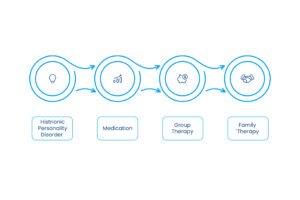
Psychotherapy
The most widespread therapy for Histrionic personality disorder is psychotherapy. It assists individuals with analyzing their thoughts, feelings, gs and actions. Various approaches are available, including cognitive behavioral therapy, and psychodynamic therapy can help get relationships and emotions under control.
Medication
The disease itself has no specific treatment. Doctors do prescribe medications, though, to help control symptoms of anxiety and depression or of mood changes. Typically, medications are given in addition to other treatments. Medication management helps ensure you take the right medications safely and effectively while monitoring their benefits and side effects.
Group Therapy
Group therapy provides opportunities for people to get to know others in the group in a supportive environment. Improved communication skills, greater self-awareness. All participants will be able to learn healthy communication and interpersonal skills.
Family Therapy
Family therapy engages tight-knit family members in therapy. It contributes to owning one’s own understanding and minimizing family conflicts. Enhancing communication can help provide a more supportive climate for all parties.
Histrionic Personality Disorder Medication
There is no histrionic personality disorder medication that is especially useful in treating a person’s RP. But psychiatrists do often prescribe drugs to help with “dual” symptoms or disorders:
- Antidepressants (SSRIs): These help with any underlying mood swings or depression.
- Anti-anxiety Medications are used for acute anxiety that is caused by partner anxiety relating to social rejection.
- Mood Stabilizers: These help to stabilize extreme and very changing thoughts.
Teen Histrionic Personality Disorder Treatment
Most of the time, doctors do not actually diagnose an adolescent with Histrionic Personality Disorder because personality traits are not fully formed throughout a Teen histrionic personality disorder treatment.
If intense emotions or attention-seeking behavior is so prominent that it interferes with everyday tasks, then early intervention and treatment may be recommended to guide teenagers to healthier relationships and emotional habits. These treatments include:
- Family therapy: To improve family communication and build a supportive environment.
- Behavioral coaching: to teach teens healthier ways to be and to recognize and eliminate bad habits.
- Emotional regulation skills: To provide healthier ways to respond to emotions.
- Identity development: For adolescents to form a confident sense of self.
Final Thoughts
Patience and understanding are essential traits for people living with or loving someone who has HPD. May be challenging to deal with explosive outbursts and attention-seeking behaviors. These actions can be signs of intense emotions and a very fragile sense of self.
What difference can support and compassion make for me for a while? People can learn to manage their stress levels and build better relationships with themselves and others if they learn to think and act differently. However, over time, growth and stability can occur.
MAVA Behavioral Health offers caring and evidence-based mental health services. It has staff who can assist individuals and families who are affected by personality disorders. With support and guidance, an individual can learn to increase their awareness and reduce the impact of HPD and live a more well-balanced life.