

There are cases when you may care about something or a situation that can take place only in the future, but has the opportunity to take place. It is because of the state known as anticipatory anxiety. Initially, know the condition and attempt to manage the situation individually.
To relax your mind, you can adopt relaxation exercises, deep breathing, or just simple mindfulness. Discussion with a reliable friend or note-taking can also serve the purpose of alleviating stress.
Nevertheless, when it becomes overwhelming or begins to impinge on your day-to-day lives, turn to professional assistance. An expert in mental health can direct you through a psychiatric assessment or medications. Read on and learn more information and valuable insights!
What Is Anticipatory Anxiety?
An anticipatory anxiety is a kind of fear that one has because they are worrying about something that has not happened yet. First of all, it is likely to manifest itself before an event that you think will be stressful, e.g., an exam, a job interview, or even a doctor visit. Your mind does not stay in the present, but instead moves on and imagines the worst things that could occur. Because of these worries, you can even strive to evade the situation, and this can heighten the state of anxiety.
In addition, to become more familiar with it, you can imagine the anticipatory anxiety as consisting of overstimulation of the alarm system in your brain. Therefore, as much as it wants to protect you by itself, it acts against it and becomes rather a source of more stress than good. Moreover, a short conversation with a counselor or a therapist can provide you with effective means to cope with such feelings.
Anticipatory Anxiety Symptoms
The following are symptoms of anticipatory anxiety:
- Irresistible racing thoughts.
- Dyspnea or rapid respiration.
- Shakiness or rigidity of muscle.
- Sweating or clammy hands.
- Inability to concentrate or focus.
- Being fidgety, jumpy, or jump scared.
- The feeling of imminent doom or fear.
- Eschewing anxiety-evoking situations.
What Does Anticipatory Anxiety Feel Like?
Anticipatory anxiety may be defined as a period of worry each time about something that is yet to be experienced. It can also be a good idea to discover that your mind is playing tricks with you and imagining the worst-case scenario, and so you find it hard to concentrate on what is going on. They can give a physical answer to such impressions, and you may experience quick, strained muscles or even have pains in your stomach.
Moreover, daily chores may appear to be daunting because of this form of anxiety. You could skip social events, crucial meetings, and even minor errands, for instance, because you are afraid of what could go wrong. This anticipation, in the long run, may exhaust you and agitate or weary you. Nevertheless, you will be able to regain control with less difficulty and feel lower levels of worry due to the ability to recognize such emotions at the initial stages and implement relaxation or grounding exercises.
Is Anticipatory Anxiety OCD?
The anticipatory anxiety is not identical with the obsessive-compulsive disorder (OCD), yet the two might be similar in other ways. Anticipatory anxiety is when you worry about what is going to happen next, or you worry that something bad is going to happen, but you cannot identify the cause of this bad thing. This continuous wondering of what could have happened is what may affect the body physically, like a racing heartbeat depression or a hyper-irritable nervous system.
However, it is worth noting that anticipatory anxiety could manifest together with OCD. An obsessive person may, as an illustration, be obsessed with the prospect of whether they can make it through their rituals. Because of this, the two conditions overlap at similar times. When these issues or habitual ways of life start to meddle with the normal way of life, visiting a mental health provider can be a good way to go in an attempt to receive treatment and help.
How To Stop Anticipatory Anxiety?
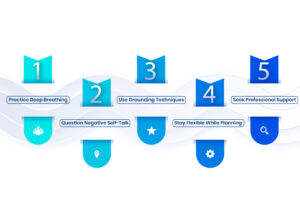
1. Practice Deep Breathing
The perspiration will relax the body and the mind. Breathing slowly in with your nose, counting in seconds, then breathe out through your mouth. Once you focus on breathing, you forget about anxious thoughts. It is easier to stay down to earth when one is under stress, when one does it every day.
2. Question Negative Self-Talk
The anticipatory anxiety tends to increase as a result of what-if thinking. When something that concerns you comes along, softly ask yourself whether it is realistic or if it is only fear talking. You can also think of patterns by writing down these worries. This will eventually train your mind not to panic and be reasonable.
3. Use Grounding Techniques
When you are thinking, grounding helps you stay in the present. Attempt to observe five things you see, four things you feel, three things you hear, two things you smell, and one thing you taste. This is a basic workout that gets you in touch with now. It makes your body think that you are not in danger at this moment. The frequency of use diminishes the strength of anxious thoughts about the future.
4. Stay Flexible While Planning
The uncertainty can be minimized through planning, but one should be flexible. Create a simple plan of what to do or what is going to happen, rather than preparing too much. Remind yourself that not all things can be controlled, and that is all right. With a plan, you know you are confident, and with unexpected things, you learn how to be resilient. Such a balance reduces anxiety disorder situations.
5. Seek Professional Support
In some cases, individuals find that anticipatory anxiety is so great that they cannot handle it by themselves. Coping skills can be taught to a client by a therapist or counselor, and emotional support can be provided. CBT treatments are very effective in minimizing anxious thoughts. In case of necessity, a psychiatrist can prescribe medication to mitigate symptoms. Aggressive help-seeking is a sign of strength and can accelerate your healing.
Tips for Overcoming Anticipatory Anxiety
Here are the anticipatory anxiety tips you can apply:
- Take in huge breaths to tune your mind and slow down your mind.
- Negative thinking should be substituted with realistic thinking.
- Be there, ground, watch the vision, and listen.
- Imagine yourself handling circumstances without any problem.
- Keep fit with physical activities, a healthy diet, and sleep.
- Enlist the services of a good friend, counselor, or support crew.
Related Read: Treatment of Free-Floating Anxiety through Medication Management
Anticipatory Anxiety Treatment Options
Anticipatory Anxiety Test
Anticipatory anxiety has no specific medical test, though some of the techniques nurses apply in analyzing symptoms are psychological tests and structured interviews. Such tests usually enquire about your emotional, thought patterns, and physical feelings before stress-inducing events. You can use online questionnaires of self-screening to find out whether your symptoms are related to anticipatory anxiety, but a professional examination can make the diagnosis.
Best Medication for Anticipatory Anxiety
The most suitable drug that works with anticipatory anxiety is subjective and based on the people and the intensity of the symptoms. Selective serotonin reuptake inhibitors (SSRIs) that include sertraline or escitalopram to suppress anxiety adverse effects. In extreme cases, healthcare providers may apply a short-term relief with benzodiazepines such as lorazepam. However, the long-term use of benzodiazepines should be avoided, as an addictive effect is likely to appear. Beta-blockers impact some individuals positively in the sense that physical symptoms such as heartbeat acceleration before the occurrence of stressful events are put under control.
Final Note
The problem of anticipatory anxiety disorder may disrupt day-to-day living, yet with the help of early intervention, it doesn’t matter. We treat patients compassionately at MAVA Behavioral Health through psychiatric assessments and medications to alleviate mental and physical symptoms. Our certified healthcare providers work diligently to evaluate your needs and build a treatment plan according to your lifestyle and objectives. We can use evidence-based medicines together with supportive advice to restore the level of control, lessen the apprehension towards the events happening in the future, and develop your emotional resilience and support. Contact MAVA Behavioral Health to begin your journey towards relief.
FAQs
What is anticipation anxiety?
Anticipatory anxiety refers to the high degree of worry or fear of or the possibility of something bad having occurred in the future. It tends to manifest itself in the fore ahead of stressful occasions, leading to lack of restfulness, speedy thoughts, and corporeal anxiety.
What is the cause of anticipated anxiety?
It may be provoked by the traumatic experiences of the past or by constant stress, or even by some anxiety illness. The symptoms also become stronger due to overthinking and fantasizing about the worst.
Treatment of anticipatory anxiety?
At MAVA Behavioral Health, the intervention normally encompasses moral support, lifestyle interventions, and, in some cases, medication control to curb mental and physical symptoms.
Will changing lifestyle assist in anticipatory anxiety?
Yes, practicing yoga and meditation, knowing how to sleep well, and eating a well-balanced diet will reduce stress and improve one’s presence of mind, making one more positive and emotionally healthy.
Is anticipatory anxiety the issue to be meditated?
Not always. Certain individuals cope well with treatments and coping mechanisms, while others respond to medications such as SSRIs or temporary use of anti-anxiety medications that a psychiatrist may prescribe.